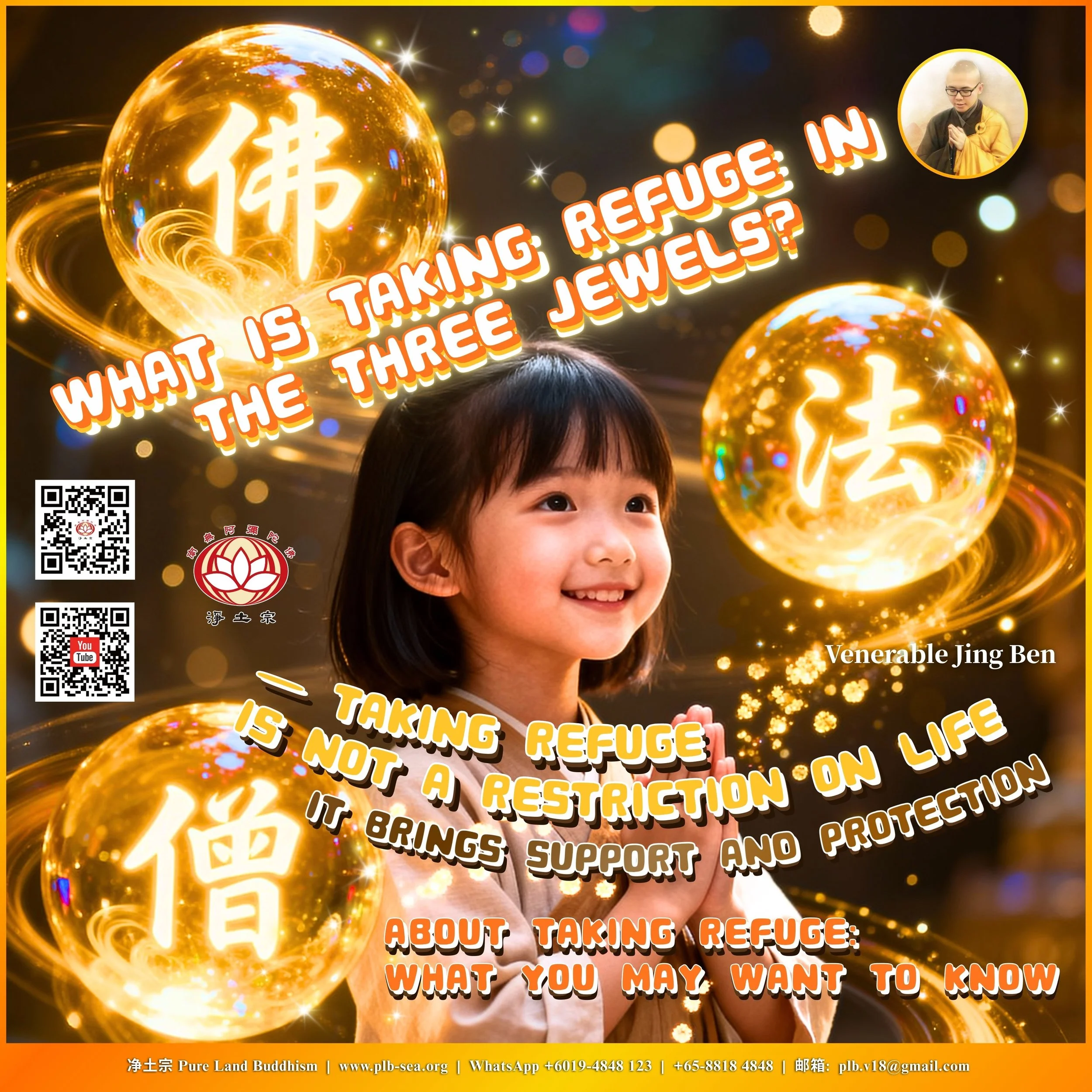
What Is Taking Refuge in the Three Jewels?— Taking Refuge Is Not a Restriction on Life; It Brings Support and Protection【About Taking Refuge: What You May Want to Know】 | Master Jingben
A devotee asks: Namo Amitabha Buddha. Respectfully seeking the Master’s guidance: How should we explain the meaning of the Three Refuges to our family members? Why do we need to take refuge? After taking refuge, what precepts do we have to observe? With gratitude to the Master.
Answer by Venerable Jingben:
Namo Amitabha Buddha. This question truly represents the feelings of many people. Quite a number of individuals wish to take refuge themselves, or to introduce their family members to take refuge. However, due to a lack of understanding, family members often develop various worries and misunderstandings.
🪷
1. Misunderstandings On Taking Refuge
Some family members may think:
Does taking refuge mean joining a religion, and as a result, no longer caring about one’s family?
Others may worry:
Does taking refuge mean becoming a monastic? Does it mean shaving one’s head?
Some even believe:
After taking refuge, are there countless rules - nothing can be eaten, nothing can be done?
Let us explain clearly first: all these assumptions are incorrect.
After taking refuge, one does not abandon one’s family, does not have to become a monastic, and certainly is not binding or restricting one’s life.
Taking refuge has never been about limiting one’s life. On the contrary, taking refuge in the Three Jewels gives our life an additional source of support and protection.
🪷
2. The Benefits of Taking Refuge
When it rains, we stay indoors to take shelter.
When the sun is scorching, we open an umbrella for shade.
When we fall ill, we consult a doctor and take medicine to recover.
Let me ask you -
Is having such protection a good thing?
Of course it is.
Taking refuge in the Three Jewels is exactly this kind of protection.
Along this long, impermanent, and unpredictable journey of life, it gives us greater stability and peace of mind.
🪷
3. Can We Truly Rely Only on Ourselves in Life?
To be honest, in this lifetime, who would dare to guarantee that relying solely on oneself is enough to pass through life safely and smoothly?
Look at the news - natural disasters, man-made calamities, accidents, illnesses, pandemics, social unrest…almost everyone will encounter, at some point, situations beyond their ability to bear. Not to mention the countless unspoken worries, pressures, and anxieties of daily life.
Therefore, by taking refuge in the Three Jewels, at the very least, we gain a reliable place of reliance when storms arise.
Ordinary people purchase many kinds of insurance - medical insurance, accident insurance, life insurance - one policy after another, fearing that something may go wrong in life without any protection.
How much more precious, then, is a form of protection that requires no payment and lasts a lifetime - the Three Jewels of the Buddha’s teaching. Such a “policy” is free, lifelong, and exceedingly rare.
To encounter even one precious treasure in a lifetime is already a great blessing. To encounter three supreme treasures at once - the Buddha, the Dharma, and the Sangha(Three Jewels) - is truly an inconceivable blessing and karmic affinity.
🪷
4. What Does Taking Refuge Truly Mean?
To put it simply, taking refuge means turning back. Turning back to rely on Amitabha Buddha.
In truth, Amitabha Buddha has always been protecting and caring for us. It is only that, in the past, we did not know this, nor did we truly recognize it.
Through taking refuge, we clearly affirm this truth: I am not alone. In this life, I am protected by the Buddha.
From the moment we take refuge, we become children of Amitabha Buddha, under the compassionate protection and loving embrace of our compassionate Father.
🪷
5. What Changes do we need to do after Taking Refuge?
After taking refuge, we are still the same person as before. However, there is one thing that truly changes: our identity is different. From the moment we take refuge, we gain a new identity - a child of the Buddha, a Buddhist disciple protected and cared for by the Buddha.
From that point of time,
the Buddhas of the ten directions watch over and protect us;
the Bodhisattvas of the ten directions become our Dharma family.
Those Bodhisattvas who took refuge before us are like elder brothers and sisters on the path. Walking through life with this understanding, our hearts naturally become more settled and at ease.
🪷
6. Will Taking Refuge Make One Passive or Negative?
No. Taking refuge only makes life better.
If, in the past, there were obstacles in life and things often did not go smoothly, after taking refuge, the situations will begin to improve gradually.
If there has been much inner suffering that one could not put into words, after taking refuge, that suffering will begin to dissolve slowly.
If one feels lost in life and unsure of direction, after taking refuge, it is as though a lamp has been lit ahead, illuminating the path forward.
Therefore, taking refuge does not make a person passive. On the contrary, it makes life lighter, more at ease, and even more joyful.
Many people once carried heavy burdens in their hearts. Yet after taking refuge -through coming to know Amitabha Buddha (the Buddha), hearing even a single line of the Dharma (the Dharma), or listening to the teachings of monastics (the Sangha) - the heart truly begins to settle, and life becomes more relaxed and at ease.
🪷
7. Is It Also Okay Not to Take Refuge?
Of course, some people may say, “Even without taking refuge, one can still listen to the Dharma and recite the Buddha’s Name.”
That is not incorrect. However, the mindset is different.
Why is that so?
Because taking refuge means that, under the guidance of a monastic, one formally declares before the Buddha: “In this lifetime, I am willing to become a child of the Buddha and to rely upon the Three Jewels.”
Is this mindset truly the same as that of someone who has not gone through the act of taking refuge? On the surface, it may appear the same. But inwardly, the experience is different.
🪷
8. The Meaning of a Vow of Taking refuge
If we observe the world carefully, we will notice that truly important matters are often accompanied by a vow.
When a man and a woman marry and become husband and wife, they make vows.
When medical students graduate and become doctors, they take an oath.
When national leaders assume office, they also take an oath.
Whether or not these vows are made, on the surface, things may seem much the same.
After marriage, daily life does not instantly change because of the vow.
Doctors already possess their skills before taking their oath.
National leaders do not suddenly gain greater ability simply because they have sworn an oath.
From a technical standpoint, a vow does not “add” ability. So why are vows still necessary?
Because the meaning of a vow lies not in outward form, but in the inner elevation of the heart. A vow is a way of telling oneself: “This is not a game. This is something to be faced seriously and undertaken with responsibility.”
The marriage vow elevates affection into commitment.
The physician’s oath adds compassion and responsibility to medical skill.
The oath of national leaders binds power with accountability.
For this reason, matters of great importance are often affirmed through vows.
Taking refuge in the Three Jewels follows the same principle. Before formally taking refuge, one’s attitude may be tentative - listening a little, observing a little, learning a little -with the heart not yet fully settled, still like an outsider standing at the gate.
But when one takes refuge in a formal ceremony, guided by a monastic, and bows sincerely before the Buddha, at that moment, the inner reliance upon and entrustment to the Three Jewels deepens profoundly. If someone says, “I don’t feel any difference,” it is very likely that they have not truly experienced taking refuge yet.
Therefore, you are warmly welcome to take refuge. And we encourage everyone to take refuge with courage and sincerity.
🪷
9. After Taking Refuge, Does It Mean Nothing Can Be Done?
Of course, some people may worry: After taking refuge, does it mean that nothing can be done anymore?
In fact, this way of thinking simply needs a small adjustment.
After taking refuge, it is not that “nothing can be done.” Rather, we become clearer about what should not be done.
True freedom has never been based on the idea that “anything goes.” If a person insists on doing whatever they please - seizing what they like and resorting to violence when they dislike something - would that not be the way of a barbaric life? Is that truly the kind of life we want? Obviously not.
In reality, taking refuge does not impose such restrictions. Because the content of taking refuge is very simple - it is merely taking refuge in the Three Jewels: the Buddha, the Dharma, and the Sangha. Whether one eats vegetarian food or observes particular precepts is not within the scope of taking refuge.
Taking refuge is simply the first step on the path of Buddhist practice. Therefore, during the process of taking refuge, there is no requirement that one must consume vegetarian food, nor is there any statement such as “if you do not eat vegetarian food, something bad will happen.” There is certainly no notion of punishment or retribution for not doing so. Such ideas do not exist.
Personally speaking, I do encourage vegetarianism whenever the conditions are right. Why? Because eating vegetarian food is healthier, creates fewer negative karmic causes, and in modern society, vegetarian food is both convenient and abundant. Since it is something beneficial, encouragement is appropriate. However, encouragement is not the same as compulsion. Encouraging someone to do something and forcing them to do it are two entirely different matters.
Therefore, there is truly no need to worry that taking refuge will bring great pressure.
On the contrary,
taking refuge should be joyful;
taking refuge should be at ease;
because a disciple who has taken refuge is protected and cared for by the Buddha.
Thus, we should move toward this positive way of thinking, rather than beginning with worry and apprehension. Once, a newcomer to Buddhism asked me nervously, “Master, I feel that after taking refuge, the pressure will be very great - this is not allowed, that is not allowed.” If one approaches taking refuge with such a mindset, then the meaning has been reversed.
Originally, taking refuge is meant to help us gain a treasure. But with negative thinking, one ends up picking up only a few small stones instead - that would truly be a great loss.
In these upcoming days, our monasteries will be holding the annual Amitabha Buddha’s Birthday Celebration and Refuge Ceremony in Malaysia Kuala Lumpur, Johor Bahru, and Singapore. Therefore, you are most welcome to take refuge. Taking refuge is something that brings benefits without any harm.
🪷
10. Can One Take Refuge Again?
Some people also ask: “I have already taken refuge before. Can I take refuge again at a Pure Land monastery?”
The answer is: Yes, certainly - there is no problem at all.
In Buddhism, taking refuge is not burdened with excessive restrictions. Some people may have practised in other traditions since childhood and may have already taken refuge. Later, as conditions mature, they come to study Pure Land Buddhism, recite the Buddha’s Name for many years, and form a deep affinity with a Pure Land practice centre. Then they wish to take refuge again at the monastery where they truly practise and feel close.
Such a motivation is completely understandable.
In principle, taking refuge is the same everywhere - it is always taking refuge in the Buddha, the Dharma, and the Sangha. However, emotionally and in terms of closeness, many people hope to formally take refuge once more at the monastery where they have genuinely settled and practised for a long time, as a heartfelt reaffirmation of reliance.
There is nothing inappropriate about this.
At Pure Land monasteries, the refuge names bestowed also feel especially dignified and intimate to many people. This is because Pure Land refuge names belong to the “Fo (Buddha)” generation. When people see such a refuge name, a natural sense of joy and reverence arises, and they often wish to receive a refuge name that includes the character “Fo”, feeling closer to the Buddha.
I often say jokingly: Originally your name might be “A-Hua,” but after taking refuge, it becomes “Fo-Hua.”“A-Hua” and “Fo-Hua” - doesn’t that sound quite different? (laughs)
Therefore, for those who have already taken refuge, it is perfectly fine to take refuge again at a Pure Land monastery if they wish to. ⸻
[Amitabha Buddha’s Birthday & Refuge Ceremony Announcement]
Especially on the auspicious occasion of Amitabha Buddha’s Birthday, taking refuge together with so many fellow practitioners, reciting the Buddha’s Name in unison, and forming Pure Land affinities together is an exceptionally rare and precious karmic condition.
At this time, three ceremonies have been scheduled on December 27, January 1, and January 4. Everyone is warmly invited to participate.
If you wish to learn more about Amitabha Buddha, you may take this time to watch the Dharma talks we have previously published online. By deepening your understanding of Amitabha Buddha, you may then take refuge during the celebration with even greater clarity and joy.
On the day of Amitabha Buddha’s Birthday, in addition to the Refuge Ceremony, there will be Dharma talks by monastics, Buddha-name recitation and sutra chanting, a collective dedication of merits, and affinity items prepared by the monastery for participants.
The program will be rich and fulfilling, and the harvest of Dharma joy will be abundant. There have been enthusiastic responses for the registration so far, with many participants travelling from other regions to attend as well. Everyone is most welcome to join. Those who wish to take refuge may register directly.
We look forward to meeting you then. Namo Amitabha Buddha.
⧉ Pure Land Buddhism ⧉
🌐 Website: https://www.plb-sea.org
🪷 Dharma: https://www.plb-sea.org/dharma
🌿 Activities: https://www.plb-sea.org/activities
📩 Contact: https://www.plb-sea.org/contact
☎️ Malaysia: +6019-4848 123
☎️ Singapore: +65-8818 4848
☎️ Johor Bahru: +6019-481 1848
✉️ Email: plb.v18@gmail.com
|Namo Amitabha Buddha|
